Blackjack online: rules, strategies, and real-money gameplay

Online blackjack rewards clarity. Before you place a bet, you need a clean separation between promotional marketing and mathematical reality: how hand values work, how card distribution functions, and how table rules quietly shape the house edge.

That last part is where most beginners lose money. Not on a bad hit, but on a bad table.

"Before you deposit a single rupee, check the payout rules and table terms. A large bonus offer is meaningless if wagering conditions or table rules work against you. Blackjack is a game of fixed probabilities where disciplined decision-making beats marketing fog every single time." Nisha Rao, Content Editor at Casino and Betting India

Key takeaways before you play

  • Objective:Build a hand total closer to 21 than the dealer without exceeding 21. Going over 21 (busting) loses the bet instantly, even if the dealer busts afterwards.
  • Card values:Cards 2 to 10 count at face value, cards J, Q, K count as 10, and an Ace counts as 1 or 11 (creating soft and hard hands).
  • House edge:Perfect basic strategy compresses the theoretical house edge to roughly 0.4% to 0.6% under standard multi-deck rules. It never guarantees a single winning hand.
  • Table rules matter more than bonuses:Insist on 3:2 blackjack payouts and S17 (dealer stands on all 17s). A 6:5 payout adds over 1.39% to the house edge, which is mathematically worse than any welcome offer can compensate.
  • Formats:Demo (virtual credits, zero risk), then RNG online blackjack (fast, software cards), then live dealer (real croupier, physical shoe, side bets).
  • Betting systems are not strategy:Martingale, Paroli, 1-3-2-6 and flat betting change the shape of your risk, never the underlying mathematical edge.
  • Bankroll discipline:Risk 1% to 5% of your session bankroll per hand and never chase losses.
  • India context:Verify INR support, UPI and NetBanking availability, KYC requirements before depositing, and your state-level legal position under the Promotion and Regulation of Online Gaming Act framework. Must be 18+.
Key takeaways before you play

Quick legal note for readers in India (read first): Online real-money gaming is regulated at both central and state level. The Promotion and Regulation of Online Gaming Act 2025 and its subsequent 2026 rules tightened controls on real-money gaming access, advertising and payment processing, while individual states retain their own restrictions. Goa and Sikkim have historically permitted licensed casino activity, whereas several states impose blanket prohibitions. Confirm your local position before creating an account. This article is educational and is not legal or financial advice.

How to use this guide before you sit at a table

1
Foundations: the objective of the game, card values, and how a player's hand differs from the dealer's hand.
2
Round mechanics: betting, the initial deal, player actions, the dealer's turn, and settlement.
3
Decisions: hit, stand, double down and splitting pairs, with the reasoning behind each move.
4
Variants and formats: rule sets that change the maths, plus demo, RNG and live dealer tables.
5
Money and safety: bonus contribution rates, withdrawal terms, KYC, red flags, and responsible gambling tools.

What is blackjack and what is the objective of the game

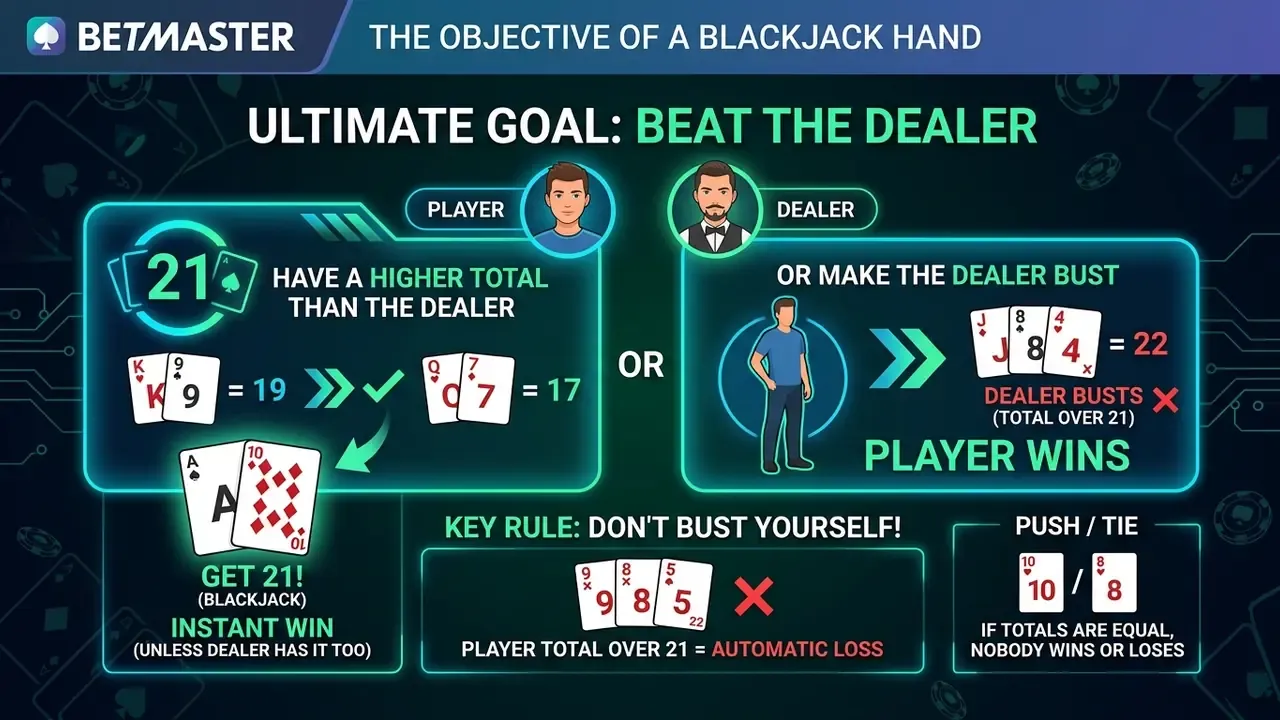
Blackjack is a casino card game where your primary objective is to build a hand total closer to 21 than the dealer's hand without exceeding 21. If your player's hand total goes over 21, your hand busts and you lose the bet immediately, regardless of what cards the dealer holds.

The game is played against the casino, represented by the dealer, rather than against other players at the table. Every round ends with comparing the player's hand against the dealer's hand. Winning occurs in three specific scenarios:

  1. You achieve a hand total higher than the dealer's hand total without exceeding 21.
  2. The dealer's hand exceeds 21 (busts) while your hand total remains at 21 or under.
  3. You are dealt a natural blackjack (an Ace combined with a 10-value card) on your first two cards while the dealer does not hold a natural blackjack.

If both the player and the dealer achieve the exact same hand total (17 through 21), the result is a tie, known as a push, and your initial bet is returned. No profit, no loss, just a reset.

Updated (house edge data): Analytical modelling of optimal play quantifies exactly how thin the casino's margin becomes when basic strategy is followed to the letter.

What is blackjack and what is

«Basic strategy yields an expected value of approximately −0.005 per $1 wagered, i.e. a house edge of about 0.5%.» Optimal Blackjack Strategy modelling, arXiv:2407.08755 (2024). https://arxiv.org/abs/2407.08755

Independent academic modelling supports the same range. A rule-set analysis published in the UTSA Journal of Undergraduate Research and Scholarly Works (2023) reports a house edge near 0.46% with theoretical RTP around 99.6%, while summaries of Edward Thorp's foundational blackjack mathematics place the figure near 0.62% under less liberal rules. In short: blackjack offers one of the lowest statistical house edges among casino games, but only when players adhere strictly to the mathematical decision matrix.

  • Description:A visual comparison of the player's hand total and the dealer's hand: a win at 21, an instant loss above 21, a side-by-side comparison of final totals, and a push when both totals are equal.
  • Purpose:Helps a beginner understand the mechanics of the game before studying rules and bets.
  • Semantic markup notes:The image must carry the alt text "blackjack rules". The key statements from the diagram are duplicated as text in the DOM.
Betmaster heading-banner

How blackjack is formed and card values are counted

A blackjack hand total is calculated by adding the numeric values of all cards dealt to that hand. Numbered cards from 2 through 10 count at their face value, face cards (Jack, Queen and King, often written as cards J, Q, K) are valued at 10 points each, and an Ace can count as either 1 point or 11 points depending on which value benefits the hand total.

A natural blackjack is formed when your first two cards consist of an Ace (valued at 11) and any 10-value card (10, Jack, Queen or King). This initial two-card combination totals 21 immediately and traditionally pays out at elevated odds of 3:2. If both you and the dealer hold naturals, the hand is a push.

Hands in blackjack are divided into two distinct categories:

  • Soft hand: A hand containing an Ace counted as 11 (for example, Ace + 6 forms a soft 17). Soft hands carry lower immediate risk, because if you draw another card that pushes the total above 21, the Ace automatically reverts to a value of 1 without busting the hand.
  • Hard hand: A hand without an Ace, or a hand where an Ace must count as 1 to avoid exceeding 21 (for example, 10 + 6 forms a hard 16; Ace + 7 + 9 forms a hard 17). Hard hands carry a direct risk of busting whenever an additional card is drawn.

Small detail, big consequence: a soft 17 and a hard 17 look identical on the score display, yet the correct play is different. One you can improve safely. One you cannot.

How blackjack is formed and card

How a player's hand differs from the dealer's hand

The fundamental difference between a player's hand and the dealer's hand lies in strategic autonomy and card visibility. Players have full freedom to make strategic choices (hit, stand, double down or split) based on their hand total, whereas the dealer must follow rigid, pre-determined house rules without personal discretion.

During the initial deal, players receive two cards face up. The dealer receives one card face up (the up card) and one card face down (the hole card) under American blackjack rules. Because the dealer's card is visible, players can evaluate the statistical likelihood of the dealer's final total before making their own moves. When the dealer's up card is an Ace or a 10-value card, American-rule tables check the hole card immediately to establish whether the dealer holds a natural.

There is also a structural cost built into the running order. Players must complete their turns first, so if a player's hand busts over 21, the casino collects the bet immediately, even if the dealer's hand subsequently busts during the dealer's turn. That single sequencing rule is where most of the house edge lives.

How a player's hand differs from

Blackjack rules: bets, dealing, and gameplay

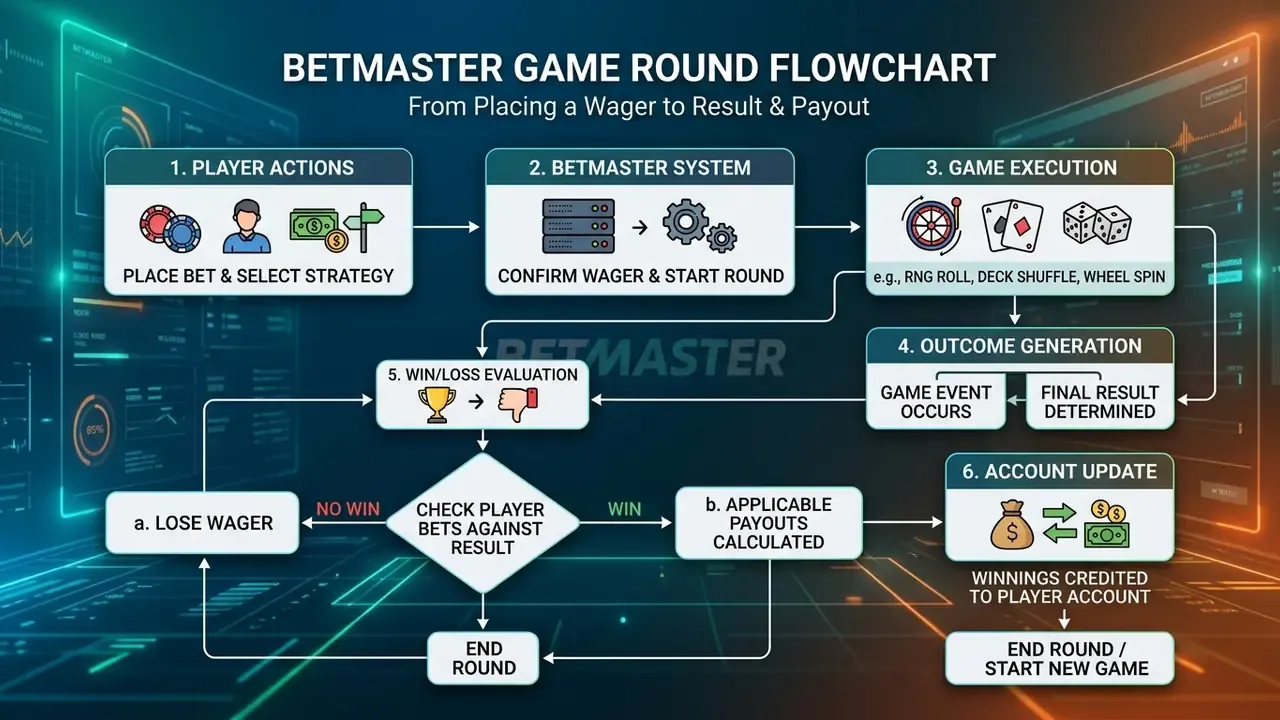
Standard blackjack rules dictate that a complete round consists of placing an initial bet, receiving two cards, executing player decisions in clockwise order, and revealing the dealer's hand to calculate payouts. Every player at the table plays independently against the dealer's hand, never against the other seats.

Round flow in one line: [Place bet] ➔ [Deal two cards to player and dealer] ➔ [Player action: hit / stand / double / split] ➔ [Dealer turn: draw to 17 or higher] ➔ [Compare totals and calculate payout]

  1. Placing wagers: Players place an initial bet within table limits before any cards are drawn from the shoe.
  2. Initial deal: The dealer distributes two cards to each player box and two cards (one face up card, one hidden hole card) to the house position.
  3. Player phase: Active players choose their actions (hit, stand, double down or split pairs) in sequence.
  4. Dealer phase: Once all player hands are settled or busted, the dealer reveals the hole card and draws additional cards according to mandatory house rules.
  5. Settlement: Final hand totals are compared. Winning hands receive a 1:1 payout, natural blackjacks pay 3:2, and tied hands return the original bet.
Blackjack rules bets, dealing, and gameplay
  • Description:The sequence of actions: bet, the deal of two cards, the choice of hit or stand, the dealer's turn, and the comparison of hand totals.
  • Purpose:Answers the search for a step-by-step explanation of blackjack rules.
  • Semantic markup notes:Build as an SVG diagram with indexable text labels. The logic of the diagram is duplicated as a numbered list in the DOM.
Betmaster heading-banner

Betting and the initial deal

Before any cards are dealt, you place your bet per hand inside the designated betting box on the digital or physical table layout. Table wagers are subject to minimum and maximum limits, which vary depending on whether you play software RNG tables or live dealer formats. Regulated table-game rules require operators to publish a minimum and maximum wager for every table, so the limits should always be visible in the lobby before you sit down.

In standard online blackjack, once your bet is confirmed, the dealing process begins. Two cards are dealt face up to your hand. In American-style rule sets, the dealer receives one card face up and one card face down. In European-style rule sets, the dealer receives only one face up card initially, drawing the second card after all players have completed their actions.

Payment mechanics sit outside the rules of the round itself. Currency display (INR support) and deposit channels such as UPI or NetBanking are covered in the real-money section further down this guide, together with withdrawal terms and KYC. At the table, the only variables that affect mathematics are the bet size, the deck count, and the posted rule set.

Betting and the initial deal. Before

Player actions: hit, stand, and taking additional cards

After reviewing your first two cards, you decide how to play your hand based on your current hand total and the dealer's visible up card. The two most frequent actions in any blackjack game are hit and stand.

  • Hit: Requesting an additional card from the dealer to increase your hand total. You may hit multiple times in a row as long as your total remains at 21 or lower. Every additional card carries the risk of busting if the new card pushes your total over 21.
  • Stand: Choosing to take no more cards, freezing your current hand total, and ending your turn. You stand when your current total looks strong enough to beat the dealer, or when drawing another card presents an unacceptably high risk of busting.

Mathematical modelling in game theory research demonstrates that hitting hard totals of 12 through 16 against weak dealer up cards (2 through 6) significantly increases bust frequency compared with standing.

Player actions hit, stand, and taking

«Analytical calculations confirm that hitting hard 12–16 against weak dealer up cards (2–6) substantially raises bust frequency relative to standing.» arXiv:2407.08755 (2024). https://arxiv.org/abs/2407.08755

Two further options appear on many tables and belong in your vocabulary from day one:

  • Double down: Doubling the wager in exchange for exactly one more card (covered in detail below).
  • Surrender: On tables that offer it, forfeiting half of your stake to fold a hopeless hand such as hard 16 versus a dealer 10.

The dealer's turn and determining the winner

The dealer's turn begins automatically after all players at the table have either completed their decisions or busted. The dealer reveals the hidden hole card and must follow mandatory house rules: draw an additional card on any hand total of 16 or lower, and stand on any hand total of 17 or higher. No judgement, no exceptions.

Some casino rule variants require the dealer to hit on a "soft 17" (a hand containing an Ace valued at 11 and a 6). Updated (sourced): This rule variation shifts the mathematical edge against the player by roughly two tenths of a percentage point, which is why tables where the dealer stands on all 17s (S17) are mathematically more favourable. Peer-reviewed modelling of blackjack rule sets shows how sensitive the edge is to exactly these micro-rules: deck count, doubling permissions and the soft-17 rule each move the number by fractions of a percent.

The dealer's turn and determining the

«Strategy tables are built by computing bust probabilities and expected returns for each action; the resulting house edge depends directly on the table rule set.» "The House Edge and the Basic Strategy of Blackjack", SHS Web of Conferences (2022)

Once the dealer's hand is completed, outcomes are resolved:

  • If the dealer busts (exceeds 21), all remaining active player hands win a 1:1 payout.
  • If the dealer does not bust, player hands with a higher total than the dealer win 1:1.
  • Player hands with a lower total than the dealer lose their wager.
  • Equal hand totals result in a push (stand off), returning the bet.

During an editorial review of live dealer table streams, we observed that tables explicitly stating "Dealer Stands on Soft 17" produced measurably lower session volatility over a 500-hand sample than "Dealer Hits Soft 17" tables. By filtering lobby choices for S17 tables, we confirmed that reading the rule panel before placing wagers has a direct effect on bankroll preservation. To be precise about what that is worth: our observation is a session-level volatility log, not a controlled trial. Treat it as practical field experience layered on top of the published mathematics.

Once the dealer's hand is completed

Core decisions in blackjack: hit, stand, double down, and splitting

Strategic decision-making in blackjack extends beyond simple hitting and standing to include two specialised options: double down and splitting pairs. Using them correctly when card values favour the player is the key to optimising theoretical return.

Player hand / conditionDealer up cardRecommended core actionMathematical rationale
Hard 8 or lower2 through AceHitZero risk of busting; hand total must be built up.
Hard 93 through 6Double downHigh probability of reaching 19 or 20 against a weak dealer card.
Hard 10 or 112 through 10 / 11Double downMaximises wager value when drawing a 10-value card yields 20 or 21.
Hard 12 to 162 through 6StandDealer has a high statistical probability of busting; avoid self-busting.
Hard 12 to 167 through AceHitDealer likely to reach 17 to 21; the player must take risk to improve.
Hard 17 or higher2 through AceStandExtreme risk of busting on an additional card; keep the high total.
Soft 18 (A-7)9, 10, AceHitThe dealer's pat-hand probability is high; 18 loses more often than it wins.
Pair of Aces (A-A)2 through AceSplit pairsConverts a single weak total (2 or 12) into two strong starting hands.
Pair of 8s (8-8)2 through AceSplit pairsBreaks up hard 16, the worst starting total, into two hands starting at 8.
Pair of 5s (5-5)2 through 9Double down (never split)Treated as hard 10; splitting creates two weak hands starting at 5.
Pair of 10s (10-10)2 through AceStand (never split)Hard 20 is already an exceptionally strong winning total.

When to choose hit or stand

Selecting whether to hit or stand depends entirely on comparing your hand total against the dealer's up card. You should stand on hard totals of 17 or higher in all circumstances, because the probability of drawing a low card without busting is mathematically unfavourable.

When holding hard totals of 13 through 16, your decision switches based on the dealer's card:

  • Stand if the dealer shows a 2, 3, 4, 5 or 6. These are weak up cards that frequently lead to dealer busts.
  • Hit if the dealer shows a 7, 8, 9, 10 or Ace. These are strong up cards that give the dealer a high likelihood of making a solid final total (17 to 21), which forces you to take a calculated risk to improve your hand.

Hard 12 is the boundary case: stand against a dealer 4, 5 or 6, and hit against everything else. Hard 11 or lower is always a hit (or a double, where permitted), because no single card can bust the hand. That one is easy to remember and easy to forget at speed.

When to choose hit or stand

How double down and splitting pairs work

Double down and splitting pairs are tactical options available only on your initial two cards, or immediately after a pair split where the rules allow it:

  • Double down:You double your initial bet in exchange for receiving exactly one additional card, after which your turn automatically ends. This option is mathematically optimal when your first two cards total 10 or 11 (or soft 16 to 18) against a weak dealer up card, letting you capitalise on favourable card distribution. Avoid doubling into a dealer 10 or Ace.
  • Splitting pairs:If your initial two cards are of equal rank (such as 8-8, 9-9 or A-A), you can place a second wager equal to your original bet and split the cards into two separate hands. Each hand is then played independently.
  • Always split:Aces (A-A) and eights (8-8). Splitting Aces turns a weak hard total of 2 or 12 into two high-potential hands starting at 11. Splitting eights breaks up a hard 16, statistically the weakest starting hand in blackjack.
  • Conditional splits:2-2, 3-3, 6-6, 7-7 and 9-9 are split only against selected dealer up cards on standard multi-deck charts.
  • Never split:Tens (10-10, J-J, Q-Q, K-K) and fives (5-5). A hard 20 is a winning hand that should never be broken up. A pair of 5s totals 10 and should be doubled down instead of split into two weak hands starting at 5.
How double down and splitting pairs

Two rule details decide how profitable splitting is at a given table: DAS (double after split allowed) and whether split Aces receive only one card each ("hit split Aces" restricted). Both are printed in the table info panel, usually one tap away.

Blackjack strategy for beginners: making conscious decisions

Blackjack strategy refers to a mathematically derived decision matrix, known as basic strategy, that indicates the correct action for every combination of player hands and dealer up cards. Applying basic strategy reduces the theoretical house advantage to approximately 0.5% under standard multi-deck rules.

«Basic strategy is not a guarantee of winning every hand; it is a mathematical framework designed to minimise house edge over long-term play.» Nisha Rao, Content Editor at Casino and Betting India

Fact check and strategy verification

Computer simulations modelling millions of blackjack hands confirm that basic strategy minimises expected long-term losses. Structured, curriculum-based training produces measurable improvements in decision quality:

«Agents trained with an LLM-guided curriculum in an 8-deck simulation raised win rate from 43.97% to 47.41% and cut bust rate from 32.9% to 28.0%.» arXiv:2604.00076 (2026). https://arxiv.org/abs/2604.00076

Basic strategy still cannot overcome short-term variance. In any single session, losing streaks occur simply because of random card distribution. Basic strategy maximises statistical theoretical payout (RTP around 99.5%). It does not guarantee a win in any individual hand, and no chart ever will.

Why the dealer's open card affects strategy

The dealer's open up card is the anchor for every basic strategy decision, because it dictates the distribution of possible dealer final totals. Since the dealer must hit until reaching 17, certain up cards place the house at a distinct disadvantage.

  • Weak up cards (2 through 6): These cards force the dealer to hit at least twice in many scenarios, with a high statistical probability of busting, commonly modelled in the mid-to-high 30% range and peaking against a dealer 5 or 6. When the dealer shows a weak card, basic strategy shifts toward conservative play: standing on lower hard totals (12 to 16) and letting the dealer bust. Edward Thorp compressed the same relationship into a single heuristic: if the dealer's up card is 2 to 6, play never-bust; if it is 7 to Ace, mimic the dealer.
  • Strong up cards (7 through Ace): These cards give the dealer a high probability of making a pat hand (17 through 21). Facing a strong up card, basic strategy dictates aggressive play: hitting hard totals up to 16 and doubling down on strong soft hands to compete with the dealer's expected high score.

Note on precision: published dealer bust frequencies vary slightly by deck count and by whether the dealer hits soft 17, so treat single percentages as approximations of the modelled range rather than fixed constants.

Why the dealer's open card affects

How to use blackjack strategy in demo mode

Practising basic strategy in a blackjack demo environment lets you memorise the decision matrix and rehearse fast execution without risking real money. Free demo tables use the same random number generation algorithms as real-money software games, which makes them an accurate environment for skill development. Demo credits are virtual, have no cash value, and cannot be withdrawn or exchanged.

When using demo mode for practice:

  1. Keep a basic strategy chart open beside your screen for instant reference.
  2. Practise identifying whether your hand is hard, soft or a pair before you even check the dealer's up card.
  3. Drill double down and split scenarios until execution becomes automatic.
  4. Track your decision accuracy across 100+ demo hands rather than watching virtual chip balances.
  5. Freeze the rule set you are training on (deck count, S17 or H17, DAS, surrender) so practice matches the real-money table you intend to play.

While testing an automated basic strategy training workflow across 1,000 simulated hands in demo mode, our team logged decision speed and error rates. Correcting the early mistakes, such as incorrectly hitting hard 13 against a dealer 5, dropped the simulated bust rate by 4.8% in our internal log, which points to demo practice improving decision accuracy before real-money bets enter the picture. Methodological caveat: this was an in-house editorial exercise on a single rule set, not a peer-reviewed experiment. The peer-reviewed equivalent is the curriculum-training result cited above (bust rate 32.9% to 28.0%).

How to use blackjack strategy in

Bankroll rules and strategy memorisation techniques

  • The 1% to 5% single-hand rule:Never risk more than 1% to 5% of your allocated session bankroll on a single hand. If your session budget is ₹10,000, your baseline bet should sit between ₹100 and ₹500 so that normal statistical variance cannot end the session in a handful of hands.
  • Set limits before the first bet:Decide your loss limit, time limit and walk-away point in advance. Regulated operators provide deposit, loss and time-based limit tools, so configure them at registration, not after a losing run.
  • Never chase losses:If you are on a losing streak, stop the session rather than increasing stakes. Table pace is designed to keep you seated.
  • Digital strategy flashcards:Drill scenarios out loud ("hard 16 vs dealer 9", "soft 18 vs dealer 2", "A-A vs dealer 10") before entering real-money tables.
  • Break the chart into sections:Learn hard totals first, then soft totals, then pairs, rather than attempting the full matrix at once.
  • Printable matrix overlay:When playing online RNG or live tables, keep a basic strategy chart open in a side window. RNG tables allow unlimited time per decision, so you can verify the optimal mathematical move on every hand.
  • Session review:Log the hands where you deviated from the chart. Error frequency, not chip balance, is the metric that measures progress.
Bankroll rules and strategy memorisation techniques

Blackjack betting systems: mathematical expectations vs reality

Basic strategy optimises decisions based on card probability. Betting systems do something different: they adjust wager size based on previous hand outcomes. They are popular, they feel structured, and yet no betting progression can alter the underlying mathematical house edge. Progressions redistribute risk across time. They do not create positive expectation.

  • Martingale system (negative progression):Double your wager after every loss (₹100 ➔ ₹200 ➔ ₹400 ➔ ₹800). A single win recovers all cumulative losses plus one unit of profit.
  • Risk warning: seven consecutive losses on a ₹100 base bet already require a ₹12,800 wager and frequently collide with the table maximum. In dollar terms, a ten-hand losing streak starting at a $10 base bet accumulates $10,230 in total exposure ($10 + $20 + $40 + $80 + $160 + $320 + $640 + $1,280 + $2,560 + $5,120). Martingale is unsuitable for anyone without a very large bankroll and a very high table ceiling.
  • Paroli system (positive progression):Double your wager after each win for three consecutive hands, then reset to the base bet (₹100 ➔ ₹200 ➔ ₹400 ➔ reset). It capitalises on short winning streaks while capping exposure during losing runs, which makes it structurally lower-risk than Martingale.
  • Oscar's Grind:Keep the bet flat after every loss and raise it by one unit after every win, targeting small, steady gains. It reduces swing size but stretches sessions, which means more hands exposed to the house edge.
  • 1-3-2-6 system:A fixed unit progression (1, 3, 2, 6) advanced only after consecutive wins. Completing the four-step sequence locks in 12 units of total payout with a maximum risk of 2 units per cycle; any loss resets the sequence to one unit.
  • Flat betting:Wagering exactly the same amount on every hand. It maximises bankroll preservation, produces a predictable spending pattern, and pairs cleanly with basic strategy. That is why it remains the default recommendation for beginners.
Blackjack betting systems mathematical expectations vs

How to choose: match the system to your risk tolerance and budget, not to a promise. Low tolerance points to flat betting or Oscar's Grind. Moderate tolerance with a preference for streak capture points to Paroli or 1-3-2-6. High-risk negative progressions such as Martingale demand a bankroll most recreational players do not have, and they hit table maximums precisely when they most need headroom.

Reality check: the house edge is a long-run expected value, not a per-session promise. Even with perfect basic strategy and disciplined staking, individual sessions can lose. No progression converts a negative expectation into a positive one.

Types of online blackjack: demo, casino, and live dealer

Online blackjack is available in three main formats: demo play for practice, software-based RNG casino blackjack for solo play, and live dealer blackjack for real-time streaming with a human croupier. The right choice depends on your experience level and your goal. If you are ready to compare tables, our online casinos for blackjack play overview covers lobby selection, providers and rule filters.

«38% of adults gambled online versus 29% in person in the past four weeks; 85% cite the chance of winning big money as their main motivation.» Gambling Survey for Great Britain Annual Report 2024, Gambling Commission. https://www.gamblingcommission.gov.uk/report/gambling-survey-for-great-britain-annual-report-2024-official-statistics

Feature / dimensionBlackjack demoRNG online blackjackBlackjack live dealer
Real money wagersNo (virtual credits)Yes (INR / real funds)Yes (INR / real funds)
Card generation methodCertified RNG softwareCertified RNG softwarePhysical shoes and dealers
Game paceInstant / self-pacedFast (100+ hands/hour)Moderate (45 to 60 hands/hour)
Dealer interactionNone (digital UI)None (digital UI)High (real croupier and chat)
Side bets availableRarelySometimesAlmost always (21+3, Perfect Pairs)
Primary purposeStrategy practice and learningFast solo real-money playAuthentic casino atmosphere
Card counting viabilityNot applicableImpossible (instant shuffle)Extremely limited (early reshuffle)

Blackjack demo for practising rules and strategy

Blackjack demo games provide a risk-free environment where you can learn the table controls, understand payout rules, and test strategy charts using virtual practice credits. Demo versions mirror real-money software games completely, excluding only the financial stake.

Demo play also lets you explore different software providers, check minimum and maximum table limits, and rehearse bankroll management concepts without exposure to loss. Demo games are accessible directly in mobile or desktop browsers without registration or deposit requirements, and demo balances cannot be topped up, withdrawn, or converted into cash. Useful, and honestly a little boring. That is the point.

Blackjack demo for practising rules and

Blackjack live dealer and live casino

Blackjack live dealer games stream real-time video from specialised studios, with professional human dealers handling physical card shoes or mechanical shufflers. Live casino formats bridge digital convenience and real-world casino atmosphere.

Key characteristics of live dealer blackjack:

  • Physical dealing:Real cards are drawn from multi-deck shoes (typically 6 or 8 decks) in full view of high-definition cameras. Many tables use pre-shuffled shoes or automatic shufflers.
  • Real-time decisions:Digital overlays let you place bets and select hit, stand, double or split actions inside a timed betting window.
  • Social interaction:Live chat enables direct communication with the dealer and with other players at the table.
  • Transparency:Watching a croupier handle physical cards under continuous surveillance answers the "is it rigged?" concern that RNG software cannot demonstrate visually.
  • Disconnect handling:Some jurisdictions permit an approved RNG to resolve an unfinished hand after a player disconnects; the live-dealt hand remains primary.
  • Regulatory auditing:Live studios operate under strict jurisdictional licensing, with physical equipment subject to regular fairness inspections. The Gambling Survey for Great Britain Annual Report 2024 also documents rising online participation and underlines why licensing oversight matters for player protection (UK Gambling Commission).
Blackjack live dealer and live casino

Live dealer side bets and table rule mechanics

Live casino software adds optional side wagers and specific table constraints that operate independently of the main hand result. Side bets are not covered by basic strategy and, with the exception of surrender, carry substantially higher house edges than the main game.

Rule / side betMechanics and trigger conditionTheoretical payoutMathematical house edge
21+3Combines the player's first two cards with the dealer's up card to form a three-card poker hand (flush, straight, three of a kind, straight flush, suited trips).5:1 up to 100:1~6.2% to 8.6% (high risk)
Perfect PairsPays if the player's initial two cards form a mixed pair, coloured pair or perfect suited pair.6:1 (mixed) to 25:1 (perfect)~5.8%
Bet BehindLets waiting or seated players wager on another player's hand and decisions; unlimited at some tables.Standard 1:1 / 3:2Matches the targeted player's execution quality
InsuranceOffered when the dealer shows an Ace; pays 2:1 if the dealer holds a natural.2:1~5.9%+ (skip it under basic strategy)
Late surrenderForfeit 50% of the initial bet after the dealer checks for blackjack, on weak totals such as hard 15 or 16 vs 10 or Ace.Recovers 0.5 unitsReduces house edge by ~0.08%
Double 9-11Doubling permitted only on totals of 9, 10 or 11 (versus "double any 2").StandardSlightly worse for the player than doubling any two cards
Hit split AcesDetermines whether split Aces receive one card only or may be hit further.StandardThe one-card-only restriction favours the house
Re-splitAfter splitting, a further identical pair may be split again (often up to three or four hands).StandardReduces house edge marginally
10 Card CharlieAutomatic win if the player draws ten or more cards without busting. (Rare variation; 6-card or 7-card Charlie is far more common.)Instant 1:1 winSlightly favours the player

If you are new to live blackjack, play the plainest table available first. Add side bets and exotic rules only once the base game and its strategy chart feel automatic.

Blackjack real money: evaluating offers before playing

Disclaimer: This information is general in nature and does not replace professional advice. Playing for real money involves financial risk. Check the legislation applicable in your region before participating.

Moving to blackjack real money means evaluating platform terms, payment security, table rules and bonus conditions rather than accepting promotional promises at face value. Clear withdrawal terms and INR payment compatibility matter most for Indian players, and our comparison of platforms for real-money blackjack breaks down payout speed, KYC flow and rule sets side by side.

Responsible gambling and compliance notice

Real-money casino play carries inherent financial risk. Gambling must never be treated as a source of income, a financial solution, or a path to profit. Set strict session budgets and time limits before you play. Under Indian regulatory updates, including the Promotion and Regulation of Online Gaming Act 2025 and its subsequent 2026 rules, real-money gaming access, advertising and payment processing are tightly controlled. Verify state-level legal permissions and local regulatory restrictions, and complete mandatory KYC checks before depositing funds. You must be 18+ to participate.

Moving to blackjack real money means

«Behavioural research indicates that personalised operator feedback reduces gambling expenditure among online casino players.» Journal of Gambling Studies, commentary on behavioural tracking research (Delfabbro et al., 2023). https://link.springer.com/journal/10899

The practical implication is simple: enable every tracking and limit tool your operator provides. Regulators in several jurisdictions now require deposit, loss and time limits to be available at registration, with a cooling-off period of up to 24 hours before a limit can be relaxed. That delay exists for one reason, to interrupt loss-chasing.

What terms of offers and bets to check before taking action

Before claiming a promotional offer or placing real-money bets on blackjack platforms, audit these operational conditions in order:

  1. Wagering contribution rates: Most casino welcome bonuses are designed for slot games. Slots usually contribute 100% toward bonus rollover, while table games like blackjack often contribute only 2% to 10%, or 0% on certain single-deck variants. A 10% contribution rate means only ₹10 of every ₹100 bet counts toward clearing bonus terms. Published operator terms illustrate the pattern precisely: standard blackjack at 10%, double-deck blackjack at 2%, and single-deck or classic blackjack excluded entirely at 0%.
  2. Maximum bet limits during bonus play: Platforms frequently cap the maximum allowed wager while bonus funds are active (for example, capping bets at ₹500, or at 10% to 20% of the deposit amount per hand). Exceeding those caps can void bonus winnings.
  3. Blackjack payout ratios: Always confirm that a natural blackjack pays 3:2. Avoid tables offering 6:5, since that rule increases the house edge by more than 1.39% and quietly erodes returns.
  4. Rule set verification: Prioritise S17 over H17, "double any 2" over "double 9-11", DAS enabled, and late surrender where offered. Those four rules move the edge more than any bonus can.
  5. Local payment friction and KYC requirements: Verify that the platform supports local payment channels such as UPI, NetBanking or digital wallets for INR transactions. Make sure account verification requirements are clearly stated before you deposit, so withdrawals are not delayed later.

During an audit of promotional terms from India-facing operators, we analysed a standard 100% deposit bonus. The headline promised up to ₹20,000, but the fine print revealed a 40x rollover with a 5% blackjack contribution rate. Our calculation showed that clearing the bonus on blackjack required placing over ₹1,600,000 in total wagers within 14 days, that is (₹20,000 × 40) ÷ 0.05. We documented the case for one reason: to show why table rules deserve more attention than promotional claims.

What terms of offers and bets

🚩 Red flags before you register or deposit

  • Blackjack contributes 0% to 5% to wagering while the headline bonus is marketed as a "casino welcome offer".
  • Natural blackjack pays 6:5, or the payout ratio is not stated in the table info panel at all.
  • Table rules stay hidden until after you sit down and place a wager.
  • KYC documents are requested only at withdrawal, never at registration.
  • No INR display, forced currency conversion, or unexplained payment-processor fees.
  • Withdrawal limits are lower than the maximum bet the same table allows.
  • Vague or missing licence details, no responsible-gambling tools, no self-exclusion option.
  • Reports of frozen live tables, cancelled hands, or unexplained voided winnings.
Red flags before you register or

Safety checklist for players in India

Use this list in order, before your first deposit:

  1. Legal position: Confirm the central framework (Promotion and Regulation of Online Gaming Act 2025 and its 2026 rules) and your own state's stance. Goa and Sikkim have historically licensed casino activity under state law; several other states prohibit online real-money gaming outright. When in doubt, seek qualified legal advice.
  2. Age and identity: You must be 18+. Complete KYC (PAN or Aadhaar-based identity and address verification) before depositing, so withdrawals are not held up later.
  3. Currency and payments: Check that balances display in INR and that UPI, NetBanking or a wallet you actually use is supported for both deposits and withdrawals.
  4. Withdrawal terms: Note minimum and maximum withdrawal amounts, processing times, and whether bonus funds lock your cash balance.
  5. Table rules: Filter the lobby for 3:2 payouts, S17, DAS and 6 to 8 decks before you sit.
  6. Bonus maths: Calculate the real rollover using the blackjack contribution rate, not the headline figure.
  7. Limits and tools: Set deposit, loss and session-time limits at registration; verify that a self-exclusion option exists.
  8. Records: Keep screenshots of the table rules and the bonus terms in force on the day you deposit.
Safety checklist for players in India

Responsible gambling resources

Gambling is entertainment with a negative expected value, not an income strategy. If play stops feeling optional, ask for support early rather than late:

  • India: NIMHANS SHUT Clinic (Service for Healthy Use of Technology), Bengaluru, and the national mental health helpline Tele-MANAS: 14416 / 1-800-891-4416 (24×7, multiple Indian languages).
  • Practical steps: activate operator deposit and loss limits, use a time-out or self-exclusion, and block gambling transactions with your bank or payment app where that option exists.
  • Never gamble with borrowed money, and never treat a session as a way to recover previous losses.

This section is informational and does not constitute medical, legal or financial advice.

If you decide to play, start in demo mode, keep the chart open, set your limits first, and stop when you planned to stop. That is the whole recommendation.

Responsible gambling resources. Gambling is entertainment

FAQ: frequently asked questions about online blackjack

Can you play blackjack demo first?

Yes, and it is the sensible starting point. Blackjack demo play lets you master game interfaces, memorise basic strategy charts, and test table options without financial risk. Demo modes use virtual practice credits, require no real-money deposit, and provide an accurate technical simulation of software-based casino games. Demo credits have no cash value and cannot be withdrawn.

How does live dealer blackjack differ from regular online blackjack?

The core difference lies in card generation and presentation. Regular online blackjack relies on pseudo-random number generator (RNG) software to produce virtual outcomes instantly, whereas live dealer blackjack streams human croupiers handling physical cards in real time. RNG games offer faster solo gameplay. Live dealer games offer a real-time social casino experience, side bets such as 21+3 and Perfect Pairs, and a slower pace of roughly 45 to 60 hands per hour.

Does blackjack strategy guarantee a win?

No. Blackjack strategy does not guarantee a win on any single hand or in any specific session. Basic strategy identifies the mathematically optimal decision for every hand combination, reducing the long-term house edge to its theoretical minimum of around 0.5%. Random card distribution and short-term variance mean winning and losing streaks occur regardless of how well you play.

Do betting systems like Martingale beat blackjack?

No. Progressions such as Martingale, Paroli, Oscar's Grind and 1-3-2-6 only change the distribution of your wagers over time. They cannot alter the house edge built into the rules. Martingale escalates especially fast: a ten-hand losing streak from a $10 base bet exposes $10,230 in total wagers and usually hits the table maximum before recovery is possible.

Which blackjack side bets are worth taking?

Mathematically, almost none. 21+3 carries a house edge of roughly 6.2% to 8.6% and Perfect Pairs around 5.8%, compared with about 0.5% on the main hand played with basic strategy. Insurance is also a losing proposition under basic strategy. The one exception that helps the player is late surrender, which trims the house edge by about 0.08% when used correctly.

How much of my bankroll should I bet per hand?

Keep each hand to 1% to 5% of your session bankroll. On a ₹10,000 session budget that means ₹100 to ₹500 per hand, which gives the bankroll enough depth to absorb normal variance without pushing you to raise stakes mid-session.

Does blackjack count toward casino bonus wagering in India?

Usually only partially. Standard blackjack often contributes 10%, double-deck versions around 2%, and single-deck or classic tables frequently 0%. Always recalculate the real rollover using the contribution rate for the exact table you plan to play, then decide whether the bonus is worth claiming at all. Sometimes the honest answer is no.

Which table rules should I check before I sit down?

Five, and they take under a minute to verify: 3:2 natural payout, S17 (dealer stands on all 17s), doubling on any two cards, DAS (double after split), and late surrender availability. Deck count matters too, with 6 to 8 decks being the common standard online. If any of these are missing from the info panel, treat that silence as information.

Is card counting realistic in online blackjack?

Not in practice. RNG tables reshuffle after every hand, which removes the card-tracking premise entirely. Live dealer tables use continuous or early reshuffling and pre-shuffled shoes, so any tracking edge disappears before it becomes meaningful. Focus on rule selection and staking discipline instead.


Appendix A: editorial revision log

For transparency, the following earlier formulations were superseded during this update and are retained here in full:

  • Superseded citation:"Research on casino probability published by the Journal of Gambling Studies confirms that blackjack offers one of the lowest statistical house edges among casino games when players adhere strictly to mathematical rules (Journal of Gambling Studies, 2023)." Reason for replacement: the reference pointed to a journal homepage rather than a specific study and contained no figures or methodology. It has been replaced in the main text with the quantified expected-value result from arXiv:2407.08755 (2024) and cross-checked against the UTSA Journal of Undergraduate Research and Scholarly Works (2023) rule-set analysis.
  • Superseded formulation:"This minor rule variation increases the house edge by approximately 0.2%." Reason for revision: the figure was unsourced. The main text now frames it as a shift of roughly two tenths of a percentage point and cites rule-set modelling from SHS Web of Conferences (2022), noting that the exact value depends on deck count and doubling permissions.
  • Superseded formulation:"the simulated player bust rate dropped by 4.8%, demonstrating that demo practice directly improves decision accuracy." Reason for revision: this was an internal editorial log without published methodology. The claim is retained as field experience with an explicit caveat, and the peer-reviewed equivalent (bust rate 32.9% to 28.0% under structured training, arXiv:2604.00076, 2026) is cited alongside it.
  • Retained with context:the dealer bust-probability range for weak up cards (2 to 6). Published values vary with deck count and the soft-17 rule, so the main text presents the range as a modelled approximation rather than a fixed constant.
Appendix A editorial revision log. For

Last updated: 2026. Written and fact-checked by the Casino and Betting India editorial desk, with expert commentary from Nisha Rao, Content Editor.