Baccarat Online: Rules, Bets, Live Dealer Tables and Real-Money Play

Baccarat online is a comparing card game. The result is decided by comparing the final point totals of two hands: Player (Punto) and Banker (Banco). Simple to watch, easy to misjudge.

Before your first wager, the most valuable thing you can do is understand three things: how cards are counted, how the 5% commission works, and how local payment services (UPI, IMPS, NetBanking) actually process deposits and withdrawals in India. Most money lost by new players is not lost to bad luck. It is lost to avoidable operational mistakes, such as a name mismatch at KYC or a bonus that quietly blocks baccarat wagers.

Baccarat Online Rules, Bets, Live Dealer

«Before you deposit a single rupee or place a chip on the table, check the payout rules and the third-card drawing mechanics. Real value in online baccarat comes from understanding house edge and payment terms, not chasing bonus hype.» - Nisha Rao, editorial voice, Casino and Betting India

Key facts before you play

  • Objective:the hand closest to 9 wins. Totals are counted modulo 10, so 15 becomes 5.
  • Best mathematical bet:Banker, house edge 1.06% (payout 0.95:1 after 5% commission). Player sits at 1.24%. Tie at 8:1 costs 14.36%.
  • Avoid as a habit:side bets (Pairs 10.36%, Perfect Pair 13.03%, Either Pair 13.71%) and Dragon Tiger Tie, which can reach a 32.77% house edge.
  • No player decisions:drawing rules are fixed by the tableau. You choose which bet to place, never how to play the cards.
  • Formats:free demo with virtual credits, then RNG baccarat for real money at instant pace, then live dealer baccarat with 15 to 30 second timers.
  • Bonuses:baccarat usually contributes only 5% to 10% toward wagering, and max-bet caps apply. Clearing a welcome bonus purely on baccarat is rarely worth it.
  • India:legality depends on your state. Verify licensing, KYC name matching (Aadhaar or PAN against your casino profile) and withdrawal limits before depositing.
  • Age:strictly 18+ or 21+ depending on jurisdiction. Gambling involves financial risk and is not a source of income.
Key facts before you play

What is baccarat and which game formats are available

Baccarat is a table card game in which participants bet on one of three outcomes, Player, Banker or Tie, before the dealer or the algorithm deals any cards. That single detail explains most of the game's appeal in India: there is nothing to learn about hitting, splitting or bluffing. You pick a side, you watch, the maths does the rest.

In the modern iGaming industry the game appears in three formats: a demonstration mode (baccarat demo), a virtual online game powered by a random number generator (RNG baccarat online), and a broadcast with a human croupier (baccarat live dealer).

A short history: from Havana to Las Vegas. The roots of the game are traced to 15th-century Italy and France, but the modern Punto Banco format took shape in 1950s Cuba. Its simplified rules were popularised by Frances "Tommy" Renzoni, who ran the baccarat tables at the Capri Hotel & Casino in Havana. After the Cuban revolution of 1958 the Capri was closed, Renzoni moved to Las Vegas and launched the game at the Sands Hotel & Casino. That was the era of Frank Sinatra and the "Rat Pack", and the interest of the global elite permanently secured baccarat's status as the most "aristocratic" casino entertainment. Ian Fleming's James Bond novels and the films that followed did the rest.

In a classic baccarat game the participant makes no decisions about drawing cards during the round. Every action of the dealer is dictated by a strict, fixed rule set, known as the third-card rule. Because of this, casino baccarat is considered one of the most transparent games with a low house advantage, from 1.06% on the Banker bet.

What is baccarat and which game

«Baccarat accounts for roughly 7.4% of Nevada's combined table and card game revenue, with average revenue per table far exceeding most other games.» - Nevada Gaming Control Board, Information Sheet, FY2023. https://gaming.nv.gov/modules/showdocument.aspx?documentid=18398

For players from India, two practical factors usually decide the choice between practice mode and real-money play: whether the cashier supports local INR rails, and whether the table interface behaves properly on a mid-range Android phone over a mobile network.

Baccarat demo, online play and real-money betting

The baccarat demo mode is a free version of the game played with virtual credits. It is designed for exploring the interface, studying the result trackers (roads) and testing the rules without financial risk. Two limitations matter: winnings cannot be withdrawn, and live baccarat tables are usually unavailable, because studios with human dealers require a funded account.

The transition to baccarat real money happens after registering an account at an online casino, completing initial verification and making a deposit. Unlike the demo version, real-money play in casino baccarat requires disciplined bankroll control, awareness of the 5% commission on Banker wins, and readiness to complete the KYC (Know Your Customer) procedure before the first withdrawal. Doing KYC on day one, while you are calm and nothing is pending, is far less stressful than doing it while a payout sits on hold.

Baccarat demo, online play and real-money

Expert readiness test. Move from demo to real money only when you can (1) set a fixed session budget and keep it, (2) accept a losing session without chasing it, and (3) explain out loud why the Banker bet costs you 5% commission. If any of the three fails, stay in demo mode. There is no deadline.

Innovative live formats from the top providers

Beyond the classic table, modern studios (Evolution, Pragmatic Play, Playtech) offer modifications with higher payout potential and added interactivity. All of them buy that potential with an extra cost, so read the fee line before you play:

  • Lightning Baccarat / Golden Wealth Baccarat. Before each round, between 1 and 5 random "Lightning" or "Golden" cards are generated from a virtual 52-card deck, each carrying a random payout multiplier of 2x, 3x, 4x, 5x or 8x. When several matching cards land in a winning hand, the multipliers combine. In exchange, a 20% fee is added to the total bet when it is placed.
  • Peek Baccarat. After the initial deal, the dealer peeks at one, two, three or even four cards. If the revealed cards look favourable, the player may Double or Triple the original stake in the middle of the round. It was the first baccarat game to allow a bet adjustment after normal betting time closed. A 20% fee applies to Player and Banker bets.
  • Baccarat Squeeze / Controlled Squeeze. The ritual format: 15 or more cameras capture the dealer slowly bending and revealing the card edges, and the hand with the largest total wager is the one that gets squeezed. In Controlled Squeeze, cards are dealt face down onto glass inlays, and the player peels back an optical overlay mask on their own screen. A Macau-style VIP experience, available even without placing a bet.
  • Speed Baccarat. Cards are dealt face up and settlement time is minimised. Where a standard live round lasts around 48 seconds, Speed Baccarat compresses the cycle to roughly 27 seconds, maximising hands per session. Worth noting: faster rounds also mean faster losses if your discipline slips.
  • Bac Bo. A hybrid of baccarat and dice. Instead of cards, the Player and Banker totals are formed by the sum of two dice each, automatically shaken in four individual shakers. The highest two-dice total wins and the Tie bet pays up to 88:1.
  • Salon Privé and Dual Play. Salon Privé offers one-to-one VIP tables with a room manager, player-controlled shuffle and "Deal Now" pacing. Dual Play streams a real land-based casino table, letting online participants bet alongside seated guests.
Innovative live formats from the top

How live baccarat differs from the standard online version

The core difference between live baccarat and an RNG version is how the result is produced. In the virtual game the cards are dealt by a certified software algorithm. In live casino baccarat a human dealer works with a physical shoe in a dedicated studio, and multi-camera high-definition video transmits the shuffle, the deal and the card scanning, creating the effect of being present in a real venue.

«Across more than 100,000 simulated rounds, live dealer formats showed somewhat higher variance and a marginally larger house edge than RNG versions.» - Roger.com, Live Dealer vs RNG Casino Games Case Study (2023). https://www.roger.com/live-dealer-vs-rng/

In the digital version, the pace of the round is controlled by you. The pause between bets can last as long as you like. In baccarat live dealer, decision time is capped by a timer, typically 12 to 25 seconds; when five seconds remain, the status switches to "LAST BETS". For players who want maximum tempo, providers offer Speed Baccarat, where the full round cycle takes about 27 seconds according to public provider game descriptions. That figure is provider-declared, not independently audited, so confirm it in the specific table's Help section.

Table 1. Comparison of baccarat demo, RNG baccarat online and live baccarat

In the digital version, the pace
ParameterBaccarat DemoBaccarat Online (RNG)Live Baccarat
Dealer presentNo (software)No (RNG algorithm)Yes (live dealer)
Real-money playNo (virtual credits)Yes (deposit in INR or other currency)Yes (deposit in INR or other currency)
Round speedSet by the playerHigh (instant settlement)Fixed (15 to 30 sec, Speed ≈27 sec)
Limit rangeUnrestrictedMinimal (very low stakes available)Broad (standard tables to VIP)

Table 2. Comparative analysis: land-based casino vs RNG online vs live dealer

CriterionLand-based casinoRNG baccarat (online)Live dealer baccarat
Privacy and convenienceDress code and a physical visit requiredFull privacy, play from any devicePrivacy plus the atmosphere of a real floor
Min / max limitsHigh entry threshold (from $10 to $25)Micro stakes (from 10 to 50 INR)Flexible (from 50 INR up to VIP tables)
Social interactionFace-to-face conversation at the tableNoneChat with the dealer and other players
Speed and pace controlDepends on the dealer and other playersMaximum (pause at will)Fixed timer (15 to 30 sec, Speed ≈27 sec)
Result transparencyPhysical shoe and discard trayCertified software algorithm (RNG)Live stream with real-time card scanning
Bonuses and promotionsLoyalty and comps onlyWide, but low wagering contributionTable-specific promotions and cashback

Baccarat rules: objective of the game and card counting

The fundamental objective of baccarat is to predict which of the two hands, Player or Banker, will finish closer to 9, or to bet on a tie. In baccarat rules the value of a hand is the sum of its cards taken modulo 10: the tens digit is simply dropped.

«In casino punto banco the drawing rules are fully fixed: the player's only decision is which bet to place, not how to play the cards.» - Ethier S.N., "The Evolution of Baccarat" (2023). https://arxiv.org/abs/2309.07738

Baccarat is therefore played as pure mathematical probability. Your task reduces entirely to choosing a betting position, and nothing you do after the deal can change the outcome. That is unusual, and for some players it is exactly the attraction.

Player, Banker and Tie: which hands take part in a round

Every baccarat round involves two notional positions that receive cards: the Player hand and the Banker hand. The terms refer neither to you nor to the casino. They are simply the names of two opposing combinations, which confuses almost every beginner at least once.

The winning hand is determined by the final point total after all drawing rules have been resolved. If the Player hand has 7 points and the Banker hand has 5, Player wins. If both hands end with the same total, for example 6 and 6, a Tie is declared: Player and Banker bets are returned (a push), and only wagers placed on Tie are paid.

Player, Banker and Tie which hands

How card values are counted in baccarat

The scoring system in baccarat is unique and differs from blackjack or poker. Card values are as follows:

  • Aces: 1 point.
  • Cards 2 through 9: face value, so a 2 gives 2 points and a 9 gives 9 points.
  • Tens and picture cards (10, Jack, Queen, King): zero value.

If the sum of the cards in a hand exceeds 9, ten is subtracted from the total. A 7 and an 8 add up to 15; after dropping the tens digit the hand value is 5 points (15 mod 10 = 5). Two nines total 18, which becomes 8 points, a "natural" hand. No hand can ever bust, which is why there is no "safe" or "risky" way to play the cards.

How card values are counted in

When Player and Banker receive a third card

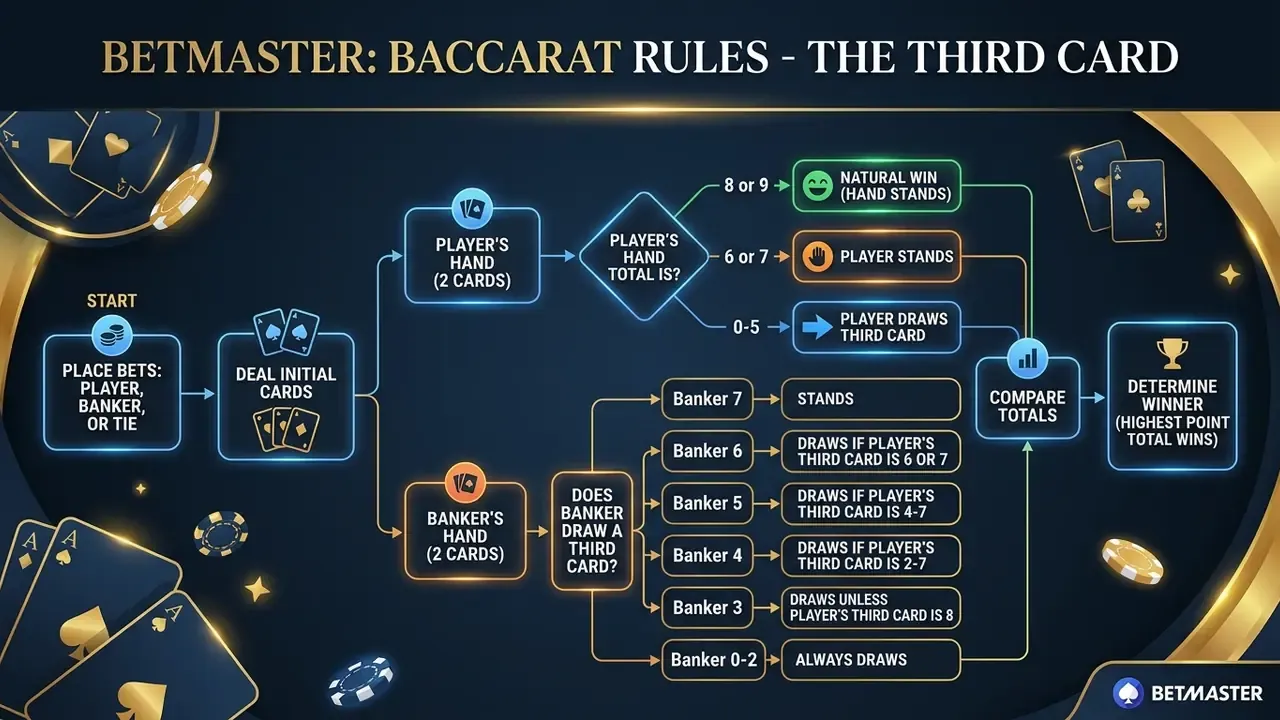
Drawing a third card is governed by a strict tableau. First comes the "natural" check: if either Player or Banker holds 8 or 9 points on the first two cards, the round ends immediately and no third card is dealt to anyone.

If there is no natural, the Player's rule applies:

  • With a total of 0, 1, 2, 3, 4 or 5, the Player must receive a third card.
  • With a total of 6 or 7, the Player stands.

The Banker rule is more complex and depends both on the Banker's current total and on the value of the third card the Player received:

  • Banker 0 to 2: always draws a third card.
  • Banker 3: draws, except when the Player's third card was an 8.
  • Banker 4: draws if the Player's third card was 2 to 7.
  • Banker 5: draws if the Player's third card was 4 to 7.
  • Banker 6: draws if the Player's third card was 6 or 7.
  • Banker 7: always stands.
When Player and Banker receive a

«The Player and Banker strategies fixed by the punto banco rules coincide with the pure Nash equilibrium of modern chemin de fer.» - Ethier S.N., "The Evolution of Baccarat" (2023). https://arxiv.org/abs/2309.07738

Note that every derived total in this tableau is itself read modulo 10. A Banker holding 3 who draws an 8 finishes on 1 (11 mod 10 = 1), which is exactly why that single exception exists. Small detail, and it explains more about the game's asymmetry than most strategy articles do.

[!NOTE] Fact check and rule verification Automated hand-value calculation and strict adherence to the third-card tableau are verified by independent testing laboratories such as eCOGRA and iTech Labs, which operate under ISO/IEC 17025 accreditation. The hand-value and third-card rules are identical across the leading providers (Evolution, Pragmatic Play, Playtech); no provider-specific deviation is documented in their published rule sheets. Even so, before playing at a specific baccarat table, open the "Help" section. In rarer No Commission or Dragon Bonus variations, side-bet payouts can differ from the baseline you assumed.

baccarat rules: Player, Banker and the third card
Baccarat rules: dealing sequence, third-card check and determining the winner

Text version of the diagram:

  1. Betting phase: the player selects a chip value and places a bet on Player, Banker, Tie or a side bet.
  2. Initial deal: the dealer deals two cards each to the Player and Banker positions.
  3. Natural check: if Player or Banker holds 8 or 9, the round ends and the winner is announced.
  4. Player rule: with 0 to 5 the Player draws a third card; with 6 or 7 the Player stands.
  5. Banker rule: if the Player drew, the Banker follows the third-card tableau; if the Player stood, the Banker draws on 0 to 5.
  6. Comparison and settlement: totals are counted modulo 10 and winning bets are paid.
Text version of the diagram 1

Bets in baccarat: Player, Banker, Tie and side bets

Baccarat bets split into the main outcomes (Player, Banker, Tie) and side bets. The range of betting options makes it possible to combine conservative, low-risk positions with high-risk ones carrying inflated payouts. Whether that combination is wise is a separate question.

The mathematical advantage of the house ranges from 1.06% on the Banker position to more than 14% on tie outcomes and pair-based side bets. This range is verified through independent combinatorial calculators, cited below, rather than through regulator revenue statistics, which do not publish per-bet house edge.

[!WARNING] The mathematical trap of side bets and Dragon Tiger Attractive side-bet odds conceal an enormous house advantage. While the Banker bet carries a house edge of 1.06%, the Tie bet takes 14.36% of expected value at 8:1. In Dragon Tiger, the simplified one-card version of baccarat, the standard Tie bet can reach a house edge of 32.77%, and the Suited Tie sits around 13.88%. Using side bets as a permanent part of your strategy is the fastest documented way to drain a deposit.

Betting on Player and Banker

A Player bet wins when the Player hand totals more than the Banker hand. The payout is 1:1, even money, and the house edge on the Player bet is 1.24%.

A Banker bet wins when the Banker hand beats the Player hand. Because of the asymmetry of the third-card rules, the Banker carries a built-in statistical advantage and wins roughly 50.68% of all decided rounds, ties excluded.

«In the standard eight-deck game the Banker wins 45.86% of all rounds, the Player 44.62%, and a tie occurs in 9.52% of cases.» - GamblingCalc, Baccarat House Edge Calculator, 8-deck punto banco (2024). https://www.gamblingcalc.com/baccarat-house-edge/

To neutralise that advantage, the casino deducts a 5% commission from Banker winnings. The net payout is therefore 0.95:1, and the resulting house edge is 1.06%, the most favourable main bet for extended play. Economically, the commission exists precisely because the Banker wins more often. Without it, the bet would be close to break-even for the house, and no operator offers that voluntarily.

The Tie bet and additional side bets

A Tie bet wins when Player and Banker finish with an equal number of points. The standard payout is 8:1; some jurisdictions and variants offer 9:1, which lowers the house edge to roughly 4.84%. Despite the attractive odds, the probability of a tie is only about 9.52%, which pushes the house edge to 14.36% at 8:1.

Side bets are settled independently of the main outcome of the round:

  • Player Pair / Banker Pair:the first two cards of the relevant hand form a pair, for example two Queens. Payout 11:1, house edge 10.36%.
  • Perfect Pair:the first two cards match in both rank and suit, for example two Eights of Hearts. Payout 25:1 for one perfect pair, up to 200:1 if both hands produce one.
  • Either Pair:wins if a pair appears in at least one of the hands. Payout 5:1.
  • Big / Small:a bet on the total number of cards in the round. Small wins if the round ends with 4 cards (payout 1.5:1), Big if 5 or 6 cards are dealt (payout 0.54:1).
  • Super 6 (No Commission tables):insurance paying 15:1 when the Banker wins with a total of 6.
The Tie bet and additional side

«Player Pair and Banker Pair carry a house edge of about 10.36%, and Either Pair around 13.7%, comparable to the worst bets in roulette.» - BaccaratCalc, Side Bet Expected Value Calculator (2024). https://www.baccaratcalc.com/side-bets/

How to compare odds and house edge

Understanding the relationship between probability and the mathematical advantage of the house is what lets you build a rational bankroll plan instead of chasing payouts. A useful habit: before you place any bet, ask what percentage of your stake the table keeps on average. If the answer is above 5%, you are paying for entertainment, not looking for value.

Table 3. Main and side bets in baccarat (8 decks)

Bet typeWinning conditionStandard payoutHouse edge
Banker betBanker total higher than Player total0.95:1 (5% commission)1.06%
Banker bet (No Commission)Banker wins; win on 6 pays 0.5:11:1, or 0.5:1 on a 6≈1.46% (≈1.02% on push-on-7 variants)
Player betPlayer total higher than Banker total1:11.24%
Tie betPlayer total equals Banker total8:1 (sometimes 9:1)14.36% (4.84% at 9:1)
Player / Banker PairFirst two cards form a pair11:110.36%
Perfect PairPair matching by suit25:1 (200:1 both hands)13.03%
Either PairPair in Player or Banker hand5:113.71%
Dragon Tiger, TieBoth cards of equal rank8:1 to 11:1up to 32.77%
Dragon Tiger, Suited TieEqual rank and suit50:1≈13.88%

How to play baccarat online and in a live casino

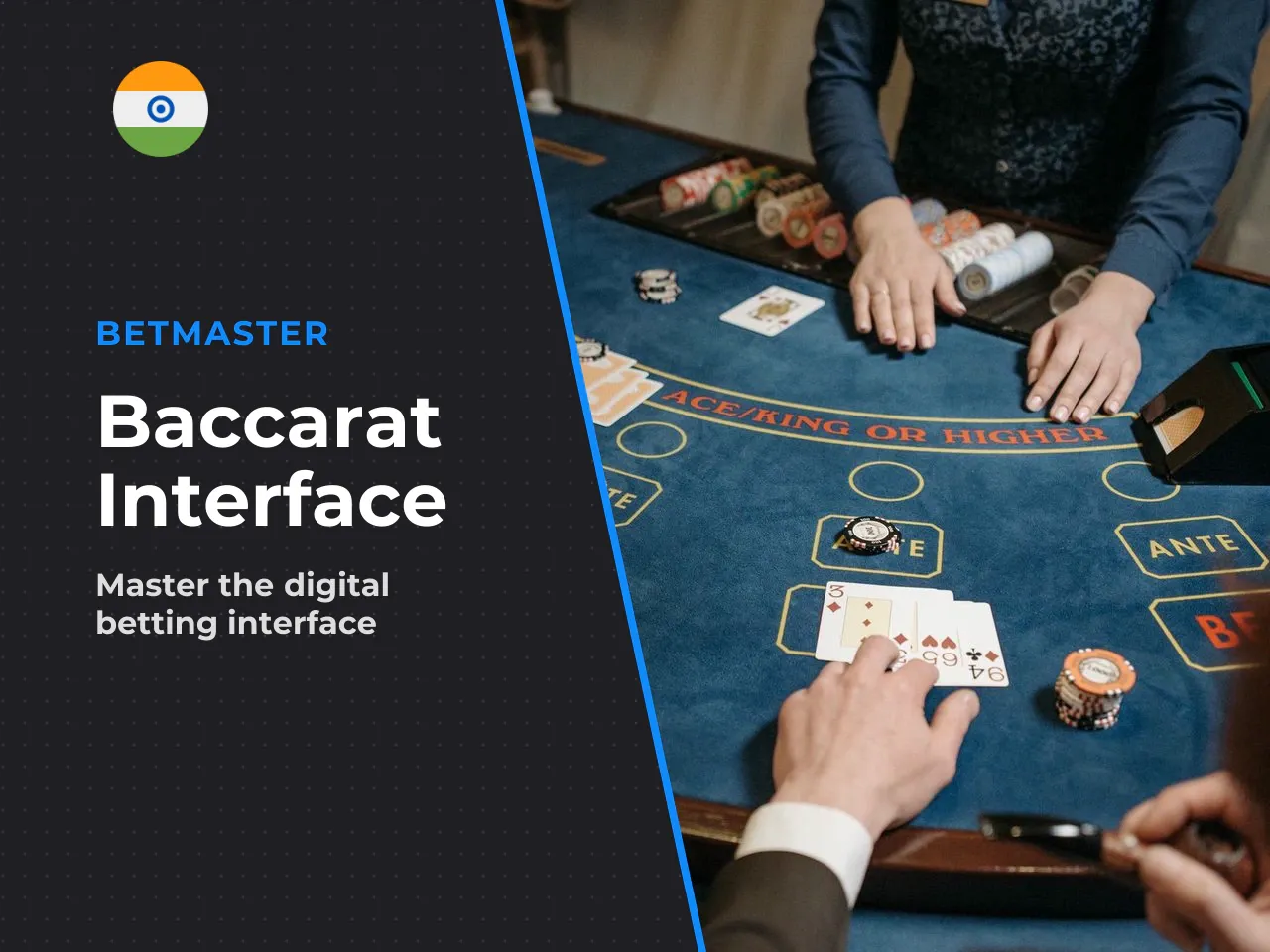
To start playing baccarat online, you complete a short sequence of actions inside the interface of your chosen platform: find a table, assess the betting range, place chips, interact with the controls.

On the Indian market one extra check matters: the stability of your connection. In live casino baccarat the betting window is fixed, and a dropped connection during "LAST BETS" cannot be undone. If you play on mobile data, test the table for a few rounds at the minimum stake before you raise it.

How to start playing baccarat at an online casino

Launching a baccarat game takes four basic steps:

  1. Choose a table in the lobby. Open the "Table Games" or "Live Casino" section and filter baccarat tables by bet limits and dealer language.
  2. Check your balance. Make sure funds are displayed in your currency, INR, so you are not mentally converting stakes mid-round.
  3. Select a chip. In the CHIP DISPLAY panel, click the denomination you need. Only chips covered by your balance will be active.
  4. Place the bet. Click the betting area on the table (Player, Banker, Tie or a side bet). Each additional click adds another chip of the selected value. Press "Confirm" if the interface requires explicit confirmation.
How to start playing baccarat at

Specifics of playing with a live baccarat dealer

In live casino baccarat the process is controlled by a real croupier, and the defining feature is the hard time window for betting. A countdown timer is displayed on screen; five seconds before it closes, the status changes to "LAST BETS", after which all betting areas become inactive and the dealer begins the deal.

Modern live dealer studios support multi-camera view switching, so you can watch slow-motion replays of the card reveal (Squeeze Control). A text chat is also available, letting you ask the dealer a question or talk to other participants at the table. Live betting statistics and interactive roads are displayed alongside the stream. Pleasant, though none of it improves your odds by a single decimal point.

Specifics of playing with a live

What to check in the baccarat table interface before betting

Before confirming a wager, experienced players inspect the following zones of the digital table:

  • Bet Limits panel:the minimum and maximum stake for each outcome type. Limits can change during a session.
  • Roadmaps / Roads:historical result grids ("Big Road", "Big Eye Boy", "Small Road", "Cockroach Pig") displaying statistics from previous rounds. Useful for tracking, but they never change the probability of the next hand.
  • Paytable:located in the "i" or "Help" menu. It confirms whether commission is deducted from Banker wins and what the side-bet coefficients are.
  • Fee notices:on Lightning, Golden Wealth and Peek tables, confirm the 20% additional fee before it is applied to your stake.
What to check in the baccarat

How to choose a baccarat casino and access an offer

Choosing a reliable online casino for real-money play means analysing three things: the licence, payment processing in India, and the transparency of bonus rules. The platform should support local payment systems (UPI, PhonePe, Paytm, IMPS, NetBanking) and publish clear withdrawal terms.

«Operators are required to disclose bonus terms, payout ratios and responsible-gambling tools transparently before real-money betting begins.» - UK Gambling Commission, Annual Report and Accounts 2023–2024. https://www.gamblingcommission.gov.uk/annual-report-2023-2024

How to verify a licence in practice. Scroll to the site footer and look for the licence number and the regulator's name (Malta Gaming Authority, Curaçao Gaming Control Board, UKGC, or a state regulator). Click the seal. A genuine licence links to the regulator's own register, where the operating company name must match the one printed in the terms and conditions. If the seal is a static image with no outbound link, treat that as a red flag and do not deposit.

Payments, KYC and withdrawals in India: a practical checklist

The most common reason a withdrawal fails is not fraud. It is a mismatch of details. Work through this list before your first deposit:

  1. Register under your legal name exactly as it appears on your Aadhaar or PAN card. If your casino profile says "Raj K." and your bank account says "Rajesh Kumar", verification can be rejected.
  2. Use a payment instrument in your own name. A friend's UPI ID or a family member's NetBanking account is the single most frequent cause of a blocked payout.
  3. Prepare documents in advance: government photo ID (Aadhaar, passport or PAN), proof of address, and if requested a screenshot of the payment account showing the name and the deposit transaction.
  4. Check the "same method" rule. Many operators return funds to the deposit method used. If you deposited by UPI, plan to withdraw by UPI.
  5. Read the minimum and maximum withdrawal limits and any monthly caps in the cashier before you win, not after.
  6. Expected timing: e-wallet and UPI withdrawals are typically processed quickly, while bank transfers take longer. Exact processing windows are operator-specific and must be read in the cashier or terms. Treat any universal figure as an estimate, never a guarantee.
  7. Never share your UPI PIN, OTP codes, full card CVV or NetBanking password with support agents. No legitimate operator ever needs them.
Payments, KYC and withdrawals in India

Bonuses and real-money conditions

Welcome bonuses in casino baccarat demand close attention to wagering requirements. Because baccarat has a low house edge, operators usually restrict how much baccarat wagers contribute:

  • Wagering contribution. At most online casinos, baccarat wagers count for only 5% to 10% of their volume. A 1,000 INR bet may contribute just 50 INR toward the rollover. This range reflects published operator bonus terms, for example tables that list "Roulette and Baccarat, 5%". The exact percentage is set by each operator and must be checked in the specific bonus terms rather than assumed.
  • Max bet cap. While a bonus is active, you may not exceed the per-round stake limit, for example 500 INR. Breaching it typically voids the bonus and any winnings derived from it.
  • Game exclusions. Some operators exclude live baccarat and No Commission tables from bonus play altogether.
Bonuses and real-money conditions. Welcome bonuses

Worked example: A player claims a 100% bonus on a 2,000 INR deposit with 30x wagering. The rollover requirement is 2,000 × 30 = 60,000 INR. If funds are wagered through baccarat at a 5% contribution rate, the real volume of bets required becomes 60,000 / 0.05 = 1,200,000 INR. The conclusion is straightforward: clearing a standard welcome bonus exclusively on baccarat is economically irrational. Either play the bonus on eligible slots, or decline it and play baccarat with cash funds at the lowest available house edge.

Security, fairness and payouts

The safety of a baccarat casino rests on technical and legal factors you can actually check:

  1. RNG certification. Online slots and virtual baccarat tables should be audited by independent laboratories (eCOGRA, iTech Labs) against randomness standards, with eCOGRA accredited to ISO/IEC 17025:2017 for game testing.
  2. Data encryption. SSL/TLS protocols must protect transactions and personal information, ideally alongside PCI DSS-grade payment handling.
  3. Payment infrastructure. Support for local Indian services (UPI, NetBanking, IMPS) and transparent payout terms. E-wallet and UPI withdrawals are usually the fastest options, with bank transfers slower; confirm the published processing times in the cashier.
  4. KYC verification. Identity confirmation (passport or Aadhaar) is required before the first withdrawal request is approved. Completing it early prevents delays at the moment you actually want your money.
Security, fairness and payouts. The safety

[!WARNING] Legal notice and responsible gambling (18+ / 21+) Access to online casinos and real-money games is permitted strictly for adults, 18+ or 21+ depending on the jurisdiction and the laws of the specific Indian state. In line with the Promotion and Regulation of Online Gaming Rules (2026), the rules and legal status of real-money gaming may differ by state, for example in Sikkim, Goa or Meghalaya. This material is informational only, does not guarantee any winnings and is not financial advice. Play responsibly: set deposit and time limits, use self-exclusion tools if you need them, and never gamble with borrowed money.

Baccarat strategy: how to approach betting consciously

Disclaimer. This information is general in nature and does not replace professional advice. Real-money gambling involves financial risk. Play responsibly and only within the law of your jurisdiction.

Applying capital-management systems in baccarat can structure a session, but it does not change the casino's mathematical expectation. Every approach must start from two facts: the house edge, and the probabilistic independence of each round.

«Variable staking strategies change the distribution of wins and losses, but they do not affect mathematical expectation, which is set by the house edge.» - "Volatility of Returns and Variable Strategies", SSRN (2023). https://papers.ssrn.com/sol3/papers.cfm?abstract_id=4612890

Published academic notes on applied gambling mathematics do describe positive and negative progressions (Paroli, 1-3-2-6, Martingale, Labouchere), but classify them strictly as staking rules that cannot alter game odds. No baccarat strategy overcomes the built-in advantage of the casino over a long distance. Session discipline matters for a second reason too, one that has nothing to do with maths:

«Gambling expenditure is more heavily concentrated among players showing signs of gambling disorder, particularly in online casino products.» - Systematic Review of Risk Curves for Gambling Harm (2024). https://www.ncbi.nlm.nih.gov/pmc/articles/PMC10900000/

Martingale, Fibonacci and Paroli in baccarat

Popular betting systems divide into negative progressions, where you raise the stake after a loss, and positive progressions, where you raise it after a win:

  1. Martingale. A negative progression: after every loss the stake is doubled. On the first win the player recovers all previous losses and gains a profit equal to the base stake.
    • Example: base stake 100 INR on Player. Loss, then 200 INR. Loss, then 400 INR. Win returns 800 INR (total outlay 100 + 200 + 400 = 700 INR, net profit 100 INR).
  2. Fibonacci. A negative progression following the sequence 1, 1, 2, 3, 5, 8, 13. After a loss the stake moves one step forward; after a win it moves two steps back.
    • Example: 10, loss, 10, loss, 20, win, back to 10.
  3. Paroli. A positive progression: after each win the stake is doubled. After three consecutive wins, or after any loss, the stake resets to the base level. This system limits the depth of drawdowns because you only ever escalate with money the casino has already paid you.

Table 4. Stake growth and risk under the Martingale system (base: 100 INR)

Martingale, Fibonacci and Paroli in baccarat
Step (loss number)Stake (INR)Cumulative outlay (INR)Profit if the bet wins (INR)
Step 1100100100
Step 3400700100
Step 51,6003,100100
Step 812,80025,500100 (table maximum likely exceeded)

The table shows the real economics of a negative progression. By the eighth consecutive loss you are risking 12,800 INR to win 100 INR, having already committed 25,500 INR. A Bond University study of baccarat found that escalating staking strategies increased total losses per shoe, and that higher table maxima simply allowed players to lose more.

Bankroll management: a short practical checklist

  • Session bankroll:allocate a fixed amount you can lose without affecting your monthly budget. That amount, not your total balance, is your session limit.
  • Stake size:keep a single bet at roughly 1% to 2% of the session bankroll. On a 5,000 INR session that means 50 to 100 INR per round.
  • Loss and win stops:decide in advance to stop at, say, minus 30% or plus 50% of the session bankroll, and close the table when either triggers.
  • Bet selection:default to Banker (1.06%) or Player (1.24%). Treat side bets as an occasional entertainment expense, never as a plan.
  • Time limits:use the operator's reality-check and time-limit tools. Live baccarat rounds are fast, and pace is what turns a small edge into a large loss.
  • Never chase:do not raise stakes to recover a losing session, and never gamble with borrowed funds.
Bankroll management a short practical checklist

Why no strategy guarantees winning

The core reason mathematical systems cannot guarantee a win is the independence of each baccarat round. The result of a previous shoe or hand has no influence on the next one. Whether the Banker has won ten times in a row or lost ten times, the probability of a Banker win in the eleventh round stays the same, roughly 50.68% excluding ties.

«People who systematically risk money can appear more successful than chance only because the risk of large losses is hidden or ignored.» - "The Martingale Index: A Measure of Self-Deception", SSRN (2023). https://papers.ssrn.com/sol3/papers.cfm?abstract_id=4590327

Negative progressions create a false sense of success through a series of small wins, which is inevitably followed by a rare but destructive losing run. Martingale is also constrained by table maximums and by the size of your deposit: a streak of 7 or 8 losses runs into the upper stake limit, making further doubling physically impossible, and at that point the accumulated loss can no longer be recovered by the system that created it. Kelly-style analysis reaches the same conclusion from the opposite direction: optimal staking maximises growth only where a positive edge exists, and in standard baccarat the player never has one.

Negative progressions create a false sense

FAQ: baccarat online questions from players in India

Should I start with baccarat demo or with real money?

Beginners should start with baccarat demo. It lets you learn modulo-10 counting risk-free, get used to the dealing speed of online tables and test the chip controls without paying tuition fees.

Move to real-money baccarat only once you have:

  1. Fully mastered the third-card order and understood the structure of the 5% Banker commission.
  2. Set a firm session bankroll and a loss limit you can absorb without touching your personal budget.
  3. Sorted out deposits and withdrawals (UPI, NetBanking) and completed account verification.

Is online baccarat legal in India?

There is no single national answer. Gambling is regulated mainly at state level: licensed casino activity exists in Goa, Sikkim and Daman, while several states prohibit online real-money games outright, and federal rules such as the Promotion and Regulation of Online Gaming Rules (2026) add further requirements. Check the current position of your own state and the operator's terms before depositing, and seek qualified legal advice where the position is unclear. This is not legal advice.

How do I withdraw winnings through UPI, and what can delay it?

Complete KYC before you request a payout, and make sure the name on your casino profile matches the name on your Aadhaar or PAN and on your bank account. Withdraw to a UPI ID or bank account registered in your own name, respect the "same method as deposit" rule where it applies, and confirm the minimum withdrawal amount in the cashier. E-wallet and UPI payouts are generally the fastest; bank transfers take longer. Exact processing windows are set by each operator, so read them in the terms rather than relying on a generic figure.

Why is a 5% commission charged on Banker wins?

Because the Banker hand acts second and follows the asymmetric third-card tableau, it wins about 45.86% of all rounds against 44.62% for Player. Without commission the bet would be profitable for the player over time, so the casino takes 5% of Banker winnings. The net result, a 0.95:1 payout and a 1.06% house edge, still makes Banker the best main bet on the table.

Which baccarat bet has the best odds, and are side bets ever worth it?

Banker is best at 1.06%, followed by Player at 1.24%. Tie is the worst main bet, 14.36% with an 8:1 payout, and pair-based side bets range from 10.36% to about 13.7%. Dragon Tiger's Tie bet can reach 32.77%. Multiplier games (Lightning, Golden Wealth, Peek) add a 20% fee to the stake as well. Treat all of these as paid entertainment, not as value.

Do roads and patterns help predict the next hand?

No. Roads (Big Road, Big Eye Boy, Small Road, Cockroach Pig) are a record of what has already happened. Each round is independent, and the shoe has no memory: after ten Banker wins the probability of the eleventh is unchanged. Roads are useful for tracking your own session and pacing, not for forecasting.

Which live baccarat variant suits a beginner best?

Start with standard live baccarat or Mini Baccarat: the lowest limits, the simplest payouts, no additional fee. Once you are comfortable with the pace, Speed Baccarat (roughly 27-second rounds) and No Commission tables are natural next steps. Leave Lightning, Golden Wealth and Peek Baccarat until you fully understand how their 20% fees affect long-run expectation.

What should I check on mobile before I deposit?

Load the table in your browser or the casino app and play a few demo rounds first. Watch for three things: how fast the stream recovers after a network dip, whether the chip panel and Confirm button are reachable with one thumb, and whether the cashier shows INR limits clearly. If the login flow or the game loading feels unreliable at 50 INR stakes, it will not improve at 500.

Before you deposit: green flags, red flags and a safe next step

A short pre-deposit review takes about ten minutes and prevents most of the problems described above.

Green flags

  • Licence number in the footer that links to the regulator's register, with a matching company name in the terms.
  • Bonus terms that state wagering, expiry, max cashout and game contribution on one page.
  • Cashier that lists INR minimums, maximums and supported rails (UPI, IMPS, NetBanking) before registration.
  • Visible responsible gambling tools: deposit limits, time limits, reality checks, self-exclusion.
  • Baccarat tables that show bet limits and the paytable in the Help section, including commission and fee lines.

Red flags

  • Static licence badges with no outbound link.
  • "Guaranteed wins", "risk-free system" or income framing of any kind.
  • Bonus terms hidden behind support chat, or wagering rules that change after you claim.
  • Support asking for your UPI PIN, OTP or full card details.
  • Withdrawal limits or monthly caps that only appear once you try to cash out.

A safe next step. If you want to try baccarat, set a session budget you can lose without consequence, complete KYC early, place minimum bets on Banker or Player, and stop when your pre-set limit triggers. If any part of that plan feels difficult to follow, stay in demo mode a while longer. Gambling is entertainment with a cost, not a way to earn. Support services exist in India, and using them early is a sign of control, not weakness.

Last reviewed in 2026, with reference to published provider rule sheets (Evolution, Pragmatic Play, Playtech), regulator documentation, and peer-reviewed and preprint research on baccarat mathematics and gambling harm. Operational figures such as withdrawal windows and baccarat's wagering contribution are operator-specific and should be verified in the cashier and bonus terms of your chosen site.

Before you deposit green flags, red